
CD-5 Candidate’s Forum
What six candidates said they would do with a seat in Congress, and how the audience judged their answers.

What six candidates said they would do with a seat in Congress, and how the audience judged their answers.
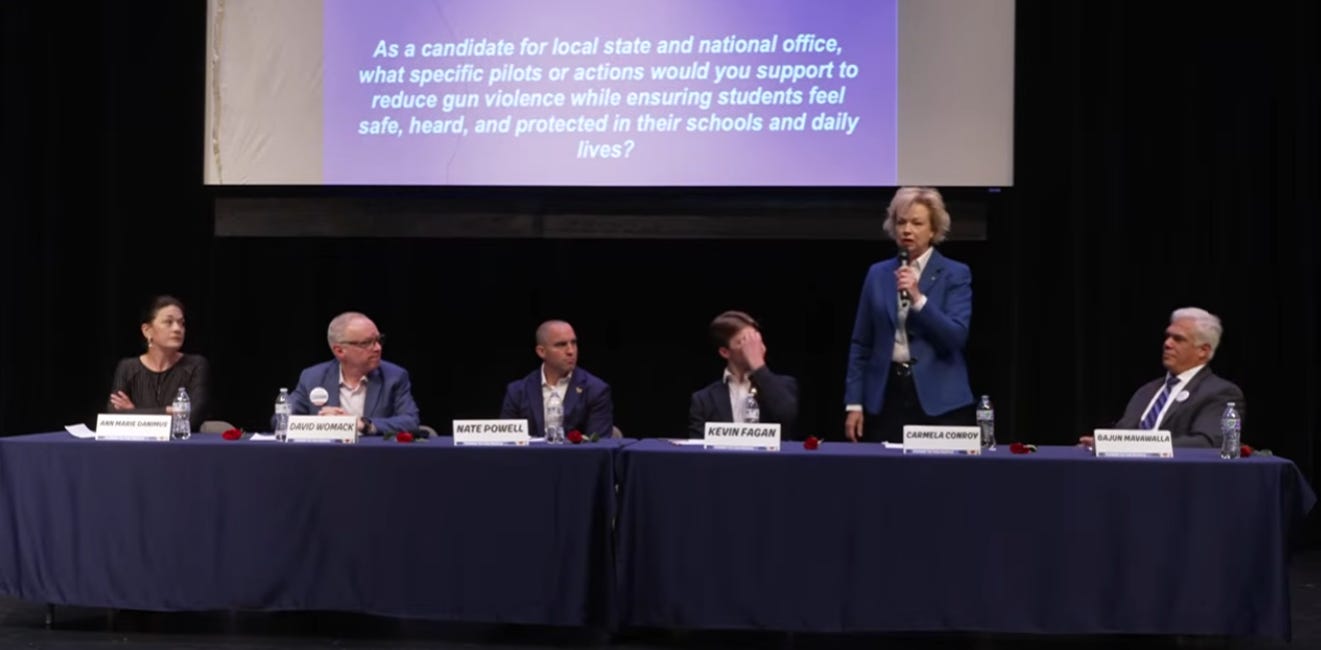
On May 30, at Mead High School in North Spokane, the organizers of the Power to the People candidate forum handed every audience member three cards. A green one to raise when a candidate said something they approved of. A red one to raise when they did not. And a ballot, to mark at the end for the candidate they judged had won. Six Democrats and independents sat on the stage, each hoping to advance from August’s primary and challenge Representative Michael Baumgartner. For two and a half hours, the audience answered the candidates in real time, in green and red, while a moderator delivered questions submitted by Eastern Washington residents.
The Detention Center Question
Patricia Castaneda, who runs Manzanita House, the Spokane nonprofit that has resettled refugees from more than a hundred countries, asked the candidates a two-part question. Homeland Security, she said, “is aggressively seeking to establish large detention facilities across the country.” If it sought to purchase property in Washington’s 5th District to house detained immigrants, she asked, how would they respond, and how would they exercise oversight of such a facility?
Kevin Fagan answered first. He would abolish ICE, he said, and if it tried to build in the district, “we would make sure to put a stop to that.” How, he did not say, beyond gutting the agency’s budget. Carmela Conroy answered next. She brought data. ICE had been handed more than a billion dollars to run “the largest detention facility system in American history,” she said, and the House could “pull that money back to stop the Department of Homeland Security and the Geo Group from imprisoning people who have never committed a crime.” Bajun Mavalwalla called detention centers something the district would “never build.” David Womack referenced the same mechanism Conroy had, “the power of the purse, to defund them.” Anne Marie Danimus spent much of her allotted time talking about fundraising, before pivoting back to the question, which she never fully answered.
Then came Nate Powell, and an audible gasp from the audience. A ban would not stop construction, he said. The facility would simply go to a state “like Idaho.” Then he added: “I would prefer to have our detention centers here.”
Red cards went up across the room.
Castaneda had asked two things: how a representative would respond to a facility, and how they would oversee one. Powell recommended where it should be built.
Humane and Orderly
Powell’s preference came with a condition: a facility here, he said, is one “where we can ensure that the work is orderly and humane.” Washington already operates such a facility, the Northwest ICE Processing Center in Tacoma, run by the GEO Group. In 2023, the state gave its Department of Health authority to inspect it. GEO sued. In August 2025, the Ninth Circuit upheld the state’s authority, rejecting the company’s claims, and issued its mandate in March 2026. Health inspectors have been turned away from the Tacoma facility ten times since 2023, twice after the court affirmed their right to enter, most recently on April 20. On April 28, the governor and attorney general asked a federal court to force GEO to let them in. The facility has drawn more than 3,500 detainee complaints; two people have died there since 2024.
Castaneda’s question was formulated in part by the established inhumane treatment of detained immigrants in facilities like the one in Tacoma. Powell failed to acknowledge the question’s sensitivity.
Another Red Card
The red cards rose again for Anne Marie Danimus, on jobs, when she voiced concern that raising the minimum wage would hurt small businesses, and she argued for a “FICA honeymoon for micro businesses.” Later, asked how to fix the federal government, she told the room to “Google it,” that artificial intelligence “will tell you exactly how to fix the US government.”
Bajun Mavalwalla’s answers were specific where Danimus’s were not. More than once, the specifics were wrong. He told the room that Tom Homan, the White House border czar, “is a CEO for a private prison company.” Between 2023 and 2025, Homan acted as a paid consultant to the GEO Group. He was never its chief executive. Mavalwalla also said the Supreme Court had ruled “that the state of Louisiana can simply declare an emergency and change their congressional districts in the middle of an election.” The Court’s ruling in April struck Louisiana’s map as a racial gerrymander and narrowed the Voting Rights Act. The ruling involved no state emergency.
The Case For Congress
Carmela Conroy stood when she provided an answer. She was the only candidate who did, for every question; the others spoke from their chairs.
Asked how she would check a president, she did not reach for a slogan. She started with the document. The job descriptions, she said, “are found in articles one, two, and three of the Constitution,” and “the first article is the legislature.” The framers “made that the most powerful branch,” she said, “because they never wanted the head of the executive branch to be able to act like a king, so they put the power of the purse in a different hand, they put that in the Congress rather than in the executive branch, which holds the sword.”
Checking a president, she said, “means withholding the money, defunding ICE, defunding out of control executive branches that are no longer following the law,” and “investigating and impeaching US government officials who are violating the laws.”
She and three rivals, Powell, Womack, and Mavalwalla, had “about 65 going on 70 years of executive branch experience” among them, she said, careers in the military, diplomacy, and public service. “That’s Article Two experience.” The job on the ballot, she argued, calls for Article One experience, the legislative power she had just described. Choose, she said, “somebody who has got the experience and the prosecutorial chops to get in there and make a difference.”
She tied it to the district. She described a town hall in Ritzville, in Adams County, a county Baumgartner carried better than four to one in 2024, where she told a room that had largely voted against her that she was running because the incumbent was not listening. There is, she said, “just one person, one elected official, whose job it is to look after Eastern Washington.”
The Verdict
Among the 201 valid ballots cast by attendees in the auditorium, Conroy finished first with 66. Mavalwalla and Womack effectively tied, at 53 and 52. Fagan drew 25. Powell drew 5. Danimus drew none. On the questions that asked what a member of Congress would actually do with the office, Carmela Conroy gave the strongest answers, and the room agreed. The count was provided by Spokane Indivisible, which noted it reflects the live audience only; the organizers may release a separate tally from the watch-party groups at a later date.