
A Monument to Himself
King George IV: the statues he built, the money he spent, and what he left behind.
By Grant Fredericks — The LeClaire Report
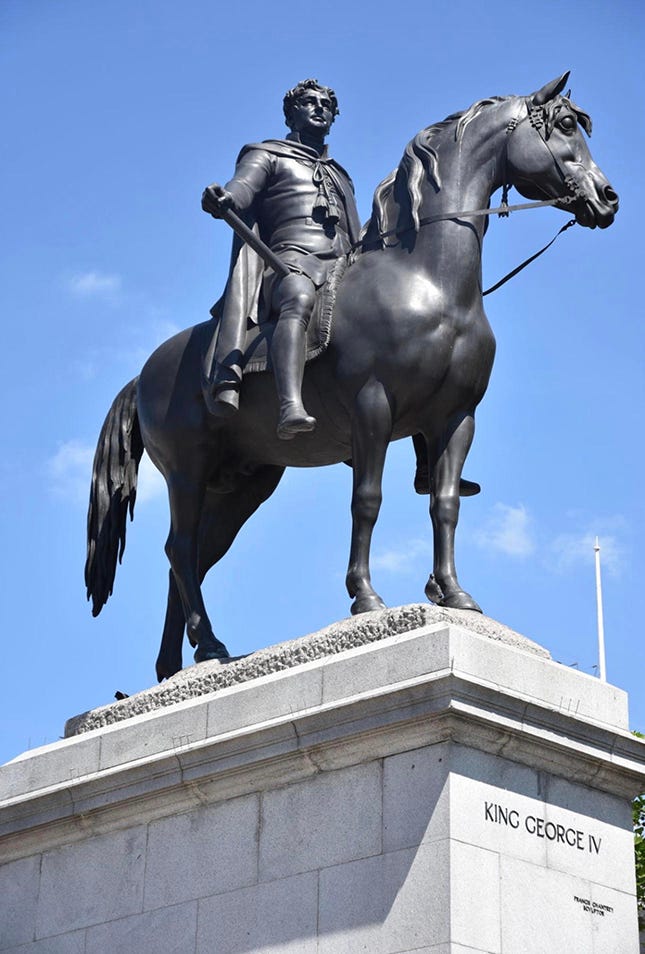
In 1828, King George IV of Great Britain commissioned an equestrian statue of himself to crown the triumphal arch he was building at the entrance to his palace. He specified the costume: that of a Roman military emperor. He chose a bareback pose.1 Cast in bronze, the svelte sculpture depicting a uniformed hero betrays the historic record of a king who had never served in arms,2 and whose fifty-inch waist required three hours each morning to be harnessed into a girdle.3 He was morbidly obese.
The equestrian statue of George IV remains today in its place of prominence in Trafalgar Square. In his ten years on the throne, he directed that his name and face be ubiquitously displayed for posterity. Much of George IV’s public life reflected a preoccupation with spectacle, image, and historical legacy. He put his name on a royal park, a commercial street, a bridge in Edinburgh, and a neighborhood in north London that carries his tribute today through one of Europe’s busiest train stations.4 He placed statues of himself in Brighton, Edinburgh and Windsor Castle, directing the pose and costume for each.5 He cast his monogram into the gates of Marble Arch, the four-story high structure covered entirely in white Carrara marble. His portrait appeared on every denomination of British coinage, from the farthing to the sovereign.6 He rebuilt Buckingham Palace, Windsor Castle, and the Brighton Pavilion, scrutinizing the architectural plans himself. The cost overruns to the public purse for his projects were substantial; for instance, Windsor Castle’s authorized expenditure of £150,000 was dwarfed by the final bill of £800,000.7
King George IV died in 1830. His statues remain in place, and the streets still bear his name.
And the monarchy never fully recovered.
The Rented Crown
George IV’s ambition was clear before he was crowned. His 1821 coronation was designed explicitly to model the pageantry of Napoleon’s Imperial coronation of 1804. He designed the ceremonial robes himself. But he refused to be crowned with the crown worn by his great-grandfather, his grandfather and his father, choosing instead to commission a new and larger crown, set with 12,314 diamonds. Due to their cost, the diamonds were rented. The king wanted to keep the crown, but Parliament refused to pay for it. The total cost for his coronation came to £238,000, more than twenty times what his predecessor had spent.8
It was not the first time Parliament had agreed to cover his expensive tastes.
In 1787, his personal debts had grown large. As a young prince, he had secretly married a widow. British law at the time barred heirs who married Catholics from the throne. She was Catholic. Rumors of the marriage were circulating in London. Had it become public, it would have cost him the throne. Allies in Parliament secured a payment of nearly £161,000. The condition: he would declare the marriage a lie, which he did publicly. His wife considered it a betrayal. He got the money.9
By 1795, he had accumulated new debts of £630,000 (the equivalent of approximately $130 million today).10 Parliament agreed to pay his creditors again. The condition: he had to marry. His father, King George III, arranged the match. The bride was his first cousin, a German princess who spoke limited English, whom he had never met.11 They separated shortly after the birth of their daughter in 1796 but remained officially married. She was forcibly prevented from attending the coronation ceremony in Westminster Abbey on July 19, 1821. She died three weeks later. The cause of her death is not known.12
The Prince of Whales
Thomas Lawrence was the most celebrated portrait painter in Britain. His coronation portrait of George IV hangs today in the throne room at St. James’s Palace.13 Lawrence was known for making unremarkable subjects appear heroic. The critic William Hazlitt observed that Lawrence had recreated the king as “a well-fleshed Adonis of thirty-three.” Londoners often referred to the king as the “Prince of Whales.”14
Nine years earlier, the Morning Post had called the would-be king “an Adonis in Loveliness.” Journalist Leigh Hunt, editor of The Examiner, offered a different observation: “a corpulent gentleman of fifty... a violator of his word, a libertine over head and ears in disgrace.” Hunt was prosecuted for criminal libel and sentenced to two years in prison.15
To George IV, image was everything.
Britain’s Worst Monarch
Historian Lucy Worsley, in 2011, named George IV Britain’s worst monarch. The assessment was sponsored by English Heritage, the institution responsible for preserving the buildings he built.16
Historian Steven Parissien concluded that George IV “sundered the contract between monarch and nation.” His reign survived, Parissien argued, despite “his appalling neglect of his office and its responsibilities.”17
Twentieth-century historian E.A. Smith argued that George IV’s reign marked “a vital stage in the transition from the personal rule of the king to the rule of Cabinet and Parliament.”18 His ministers described his behaviour as “selfish, unreliable and irresponsible.”19
Displayed for Posterity
King George IV died on June 26, 1830. He had no surviving heirs. Victoria, his niece, came to the throne seven years later. She was eighteen years old.20
Historian Jane Ridley described the monarchy Queen Victoria inherited as “deeply unpopular” and “seen as extravagant and out of touch.”21 The British public was openly calling for the monarchy to be replaced by a republic.22
The powers squandered by King George IV were not returned to the monarchy after his death. Britain’s monarchs have been ceremonial figures ever since.23
But the buildings, bridges and statues are still standing.
And we are still talking about him.
Endnotes
1. Equestrian statue of George IV commissioned 1828; Roman military emperor costume and bareback pose personally directed by George IV; statue self-funded rather than by public subscription; cast in bronze; stands today in Trafalgar Square. London Remembers memorial database. https://www.londonremembers.com/memorials/george-iv; Wikipedia, “Equestrian statue of George IV, Trafalgar Square.” https://en.wikipedia.org/wiki/Equestrian_statue_of_George_IV,_Trafalgar_Square
2. George IV held only honorary military titles and never saw active military service. Encyclopaedia Britannica, “George IV, king of United Kingdom.” https://www.britannica.com/biography/George-IV
3. George IV’s 50-inch waist and three-hour daily dressing routine. Brighton Museums and Art Gallery, “Inside George’s Breeches: The Health of George IV.” https://brightonmuseums.org.uk/discover/history-stories/inside-georges-breeches-the-health-of-george-iv/; Wikipedia, “George IV of the United Kingdom.” https://en.wikipedia.org/wiki/George_IV_of_the_United_Kingdom
4. Regent’s Park. Grub Street Project. https://www.grubstreetproject.net/places/90534/; Regent Street. Wikipedia. https://en.wikipedia.org/wiki/Regent_Street; George IV Bridge, Edinburgh. evendo.com. https://evendo.com/locations/united-kingdom/stirling/landmark/george-iv-bridge; King’s Cross. Londonist, “King’s Cross: London’s Most Hated Monument,” January 2024. https://londonist.com/london/history/king-s-cross-london-s-most-hated-monument
5. Statues of George IV in Brighton (commissioned 1822, unveiled 1828), Edinburgh (George Street, 1831), and Windsor Castle (1829); pose and costume directed for each. Wikipedia, “Statue of George IV, Brighton.” https://en.wikipedia.org/wiki/Statue_of_George_IV,_Brighton; London Remembers, George IV statues. https://www.londonremembers.com/memorials/george-iv
6. George IV’s monogram on Marble Arch central gates; arch 45 feet high, clad in white Carrara marble. marble-arch.london, “The Story of Marble Arch.” https://marble-arch.london/marble-arch-story/; London Remembers, Marble Arch. https://www.londonremembers.com/memorials/marble-arch; George IV’s portrait on every denomination of British coinage 1820-1830. oldcurrencyexchange.com, “George IV Coins.” https://www.oldcurrencyexchange.com/george-iv-coins.html
7. George IV personally scrutinized plans for reconstruction of Buckingham Palace, Windsor Castle, and Brighton Pavilion. royalpalaces.com, George IV entry. https://www.royalpalaces.com/monarchs/george-iv/; Royal Collection Trust, “A History of State Portraits.” https://www.rct.uk/collection/stories/a-history-of-state-portraits; Windsor Castle authorized £150,000, final cost £800,000. royalpalaces.com (same source).
8. George IV’s 1821 coronation modeled on Napoleon’s 1804 coronation. Wikipedia, “Coronation of George IV.” https://en.wikipedia.org/wiki/Coronation_of_George_IV; George IV designed own robes; refused predecessors’ crown; commissioned new crown with 12,314 diamonds; diamonds hired for ceremony only; crown dismantled 1823. Wikipedia, “Coronation Crown of George IV.” https://en.wikipedia.org/wiki/Coronation_Crown_of_George_IV; European Royal History blog, “Coronation Crown of George IV,” July 19, 2020. https://europeanroyalhistory.wordpress.com/2020/07/19/coronation-crown-of-george-iv-of-the-united-kingdom/; Total coronation cost £238,000; more than twenty times predecessor’s. Wikipedia, “Coronation of George IV” (same source); royal-insider.com, coronation cost comparison. https://royal-insider.com/2025/05/03/king-charles-coronation-cost-how-much-taxpayer-paid-spend/
9. George IV’s 1787 debts; secret marriage to a Catholic widow; Act of Settlement 1701. Wikipedia, “Act of Settlement 1701.” https://en.wikipedia.org/wiki/Act_of_Settlement_1701; Parliament secured £161,000 payment; condition was public denial of marriage; Fitzherbert considered it a betrayal. Catherine Curzon, madamegilflurt.com, August 2013. https://www.madamegilflurt.com/2013/08/notable-birthdays-king-george-iv.html; New World Encyclopedia, “George IV of the United Kingdom.” https://www.newworldencyclopedia.org/entry/George_IV_of_the_United_Kingdom; regencyhistory.net, “George IV and Queen Caroline: A Disastrous Royal Marriage.” https://www.regencyhistory.net/blog/george-iv-marriage-princess-caroline
10. George IV’s 1795 debts of £630,000; modern equivalent approximately $130 million. madamegilflurt.com (see Note 9); officialdata.org UK inflation calculator (£630,000 in 1795 equals approximately £97 million in 2025, converted at GBP/USD rate approximately 1.34). https://www.officialdata.org/uk/inflation/1795?amount=630000
11. Parliament agreed to pay 1795 debts conditional on marriage; George III arranged the match. encyclopedia.com, “Caroline of Brunswick (1768-1821).” https://www.encyclopedia.com/women/encyclopedias-almanacs-transcripts-and-maps/caroline-brunswick-1768-1821; Grokipedia, “Caroline of Brunswick.” https://grokipedia.com/page/Caroline_of_Brunswick; Bride was George IV’s first cousin; German princess; limited English; never previously met. Wikipedia, “Caroline of Brunswick.” https://en.wikipedia.org/wiki/Caroline_of_Brunswick; European Royal History, “April 8, 1795: Marriage of George, Prince of Wales and Caroline of Brunswick-Wolfenbuttel.” https://europeanroyalhistory.wordpress.com/2022/04/08/april-8-1795-marriage-of-george-prince-of-wales-and-caroline-of-brunswick-wolfenbuttel/
12. Separation after Princess Charlotte’s birth in 1796; Caroline remained legally George IV’s wife. Wikipedia, “Caroline of Brunswick.” https://en.wikipedia.org/wiki/Caroline_of_Brunswick; Caroline forcibly prevented from attending George IV’s coronation, July 19, 1821. historic-uk.com, “Queen Caroline of Brunswick.” https://www.historic-uk.com/HistoryUK/HistoryofBritain/Queen-Caroline/; Died August 7, 1821; refused post mortem; cause of death not established. Brighton Museums, “Caroline of Brunswick: The Injured Queen of England.” https://brightonmuseums.org.uk/discovery/history-stories/caroline-of-brunswick-the-injured-queen-of-england/
13. Thomas Lawrence pre-eminent portrait painter of his generation; 1821 coronation portrait commissioned for and hanging in throne room at St. James’s Palace. Royal Collection Trust, RCIN 405918, “George IV (1762-1830).” https://www.rct.uk/collection/405918/george-iv-1762-1830; Simon Dickinson, “Coronation Portraits.” https://www.simondickinson.com/2023/05/04/coronation-portraits/; Wikipedia, “Coronation portrait of George IV.” https://en.wikipedia.org/wiki/Coronation_portrait_of_George_IV
14. William Hazlitt’s observation that Lawrence recreated George IV as “a well-fleshed Adonis of thirty-three.” National Portrait Gallery collection notes, NPG 2503. https://www.npg.org.uk/collections/search/portrait/mw02463/King-George-IV; George IV publicly mocked as “Prince of Whales.” National Portrait Gallery collection notes, NPG 123. https://www.npg.org.uk/collections/search/portrait/mw02462/King-George-IV
15. Morning Post, 1812, describing George IV as “an Adonis in Loveliness”; Leigh Hunt’s role as editor of The Examiner and his published description. Jonathan Bate, Gresham College, “The Cockney Romantics: John Keats and his Friends,” May 14, 2019. https://www.gresham.ac.uk/sites/default/files/2019-05-14_JonathanBate_CockneyRomantics-T.pdf; Reginald Brimley Johnson, Leigh Hunt, 1896, archive.org. https://archive.org/download/leighhunt00johnuoft/leighhunt00johnuoft.pdf; Criminal libel conviction and two-year sentence. Sir John Soane’s Museum, “The Prince of Wales v. The Examiner,” 1813. https://collections.soane.org/b9110
16. Lucy Worsley named George IV Britain’s worst monarch, August 2011; assessment from English Heritage poll. Lucy Worsley blog, August 21, 2011, Goodreads (“When English Heritage ran a poll to discover Britain’s Worst Monarch…”). https://www.goodreads.com/author_blog_posts/1483837-the-naughty-prince-regent; EBSCO Research Starters, George IV. https://www.ebsco.com/research-starters/history/george-iv
17. Steven Parissien: “sundered the contract between monarch and nation.” Isabel Coates, Library Journal review (Copyright 2002 Cahners Business Information), reproduced in AbeBooks UK edition listing, ISBN 9780719556524. https://www.abebooks.com/book-search/isbn/9780719556524/; EBSCO Research Starters, George IV (corroborating). https://www.ebsco.com/research-starters/history/george-iv; “Appalling neglect of his office and its responsibilities.” Rachel Knowles, Regency History, review of George IV: The Grand Entertainment. https://www.regencyhistory.net/blog/george-iv-grand-entertainment-steven-parissien-book-review
18. E.A. Smith argued George IV’s reign marked “a vital stage in the transition from the personal rule of the king to the rule of Cabinet and Parliament.” Publisher description of E.A. Smith, George IV, Yale University Press, 1999. AbeBooks listing, ISBN 9780300076851. https://www.abebooks.com/book-search/isbn/9780300076851/
19. George IV’s ministers described his behaviour as “selfish, unreliable and irresponsible.” Wikipedia, “George IV of the United Kingdom.” https://en.wikipedia.org/wiki/George_IV_of_the_United_Kingdom; EBSCO Research Starters, George IV. https://www.ebsco.com/research-starters/history/george-iv
20. George IV died June 26, 1830. Wikipedia, “George IV of the United Kingdom.” https://en.wikipedia.org/wiki/George_IV_of_the_United_Kingdom; No surviving heirs: Princess Charlotte of Wales died November 6, 1817. Wikipedia, “Princess Charlotte of Wales (1796-1817).” https://en.wikipedia.org/wiki/Princess_Charlotte_of_Wales_(1796%E2%80%931817); Victoria was George IV’s niece; acceded June 20, 1837; eighteen years old at accession. Wikipedia, “Queen Victoria.” https://en.wikipedia.org/wiki/Queen_Victoria; EBSCO Research Starters, Queen Victoria. https://www.ebsco.com/research-starters/history/queen-victoria
21. Jane Ridley: monarchy Victoria inherited “deeply unpopular” and “seen as extravagant and out of touch.” Jane Ridley, Victoria: Queen, Matriarch, Empress, Allen Lane, 2015, p. 68. Cited via History Tools, “How Queen Victoria’s Coronation Revitalized the British Monarchy.” https://www.historytools.org/stories/how-queen-victorias-coronation-revitalized-the-british-monarchy
22. British public and republican sentiment at Victoria’s accession. National Geographic, “How Queen Victoria Remade the British Monarchy,” May 2021. https://www.nationalgeographic.com/history/article/history-queen-victoria-british-monarchy
23. George IV eroded governing authority of the monarchy; constitutional shift to parliamentary governance; British monarchs have been ceremonial rather than governing figures since his reign. EBSCO Research Starters, George IV (scholarly assessment of constitutional consequence). https://www.ebsco.com/research-starters/history/george-iv
Now you know why they say "History always repeats itself!" So sad we haven't learned from the far past - or our own recent past and find ourselves in this situation.
different name, same person....